Barcelona, Spain
← Projects
SiftCast icon
SiftCast
AI

Local news from everywhere — in your language, at your depth.

Designed to eliminate the heavy cognitive load of tracking global media, even in the age of instant translation.

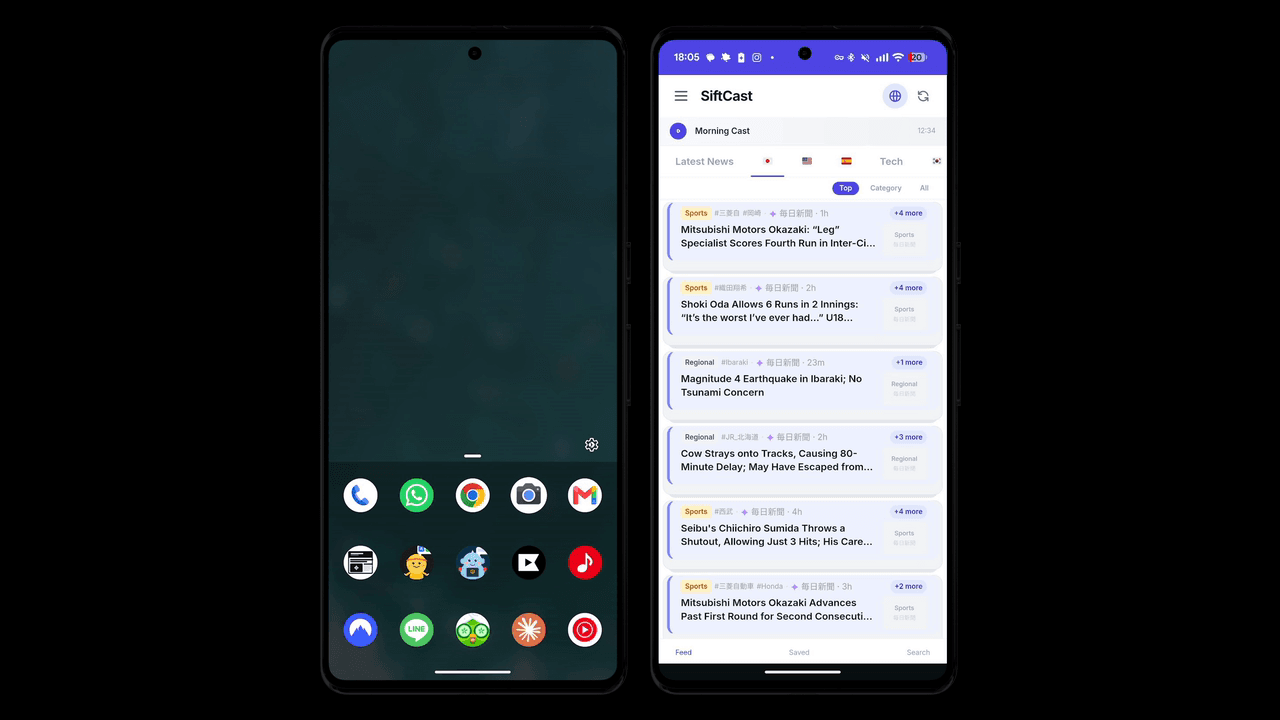
Combines background LLM summarization, custom classification, and YouTube Data API video embedding into a single, noise-free feed. Delivered as a lightweight PWA, it eliminates multi-tab context switching.

One-tap Google AI Search integration lets users instantly grasp full news context and explore topics further through conversational follow-ups.

TBD
SiftCast

01Problem → Solution

PROBLEMSOLUTION
PROBLEM 01
Every new topic you care about means switching apps and languages

The more regions you want to keep up with, the more the cost of switching apps and languages piles up. The very act of staying informed becomes a burden.

SOLUTION

With 50-plus RSS feeds and automatic translation, not having to think about which region or which language to read in becomes the default.

PROBLEM 02
Digging deeper into an article doesn't finish on one screen

Even with an article that catches your eye, grasping the context and gathering related information means crossing multiple services. Existing apps lack the experience of quickly grasping the gist and diving straight in.

SOLUTION

AI summaries, on-the-spot AI questions and search, and automatic YouTube embedding all stay inside the app, bringing exit points to zero.

PROBLEM 03
Scattered sources

While major global media are well covered, local news from specific regions lacks both the language access and the means to gather it — a structural information gap.

SOLUTION

Custom folders let you freely combine sources and categories, so you define for yourself the regions you want to keep an eye on.

  • The core experience was fixed on one point: bringing switching cost close to zero. Breadth of supported languages and regions was deliberately left out of the initial scope. Testing is focused on four language spheres with very different grammar and media characteristics — Japanese, Spanish, English, and Korean.

02Key features

01

AI-Driven Curation (intelligent AI aggregation and classification)

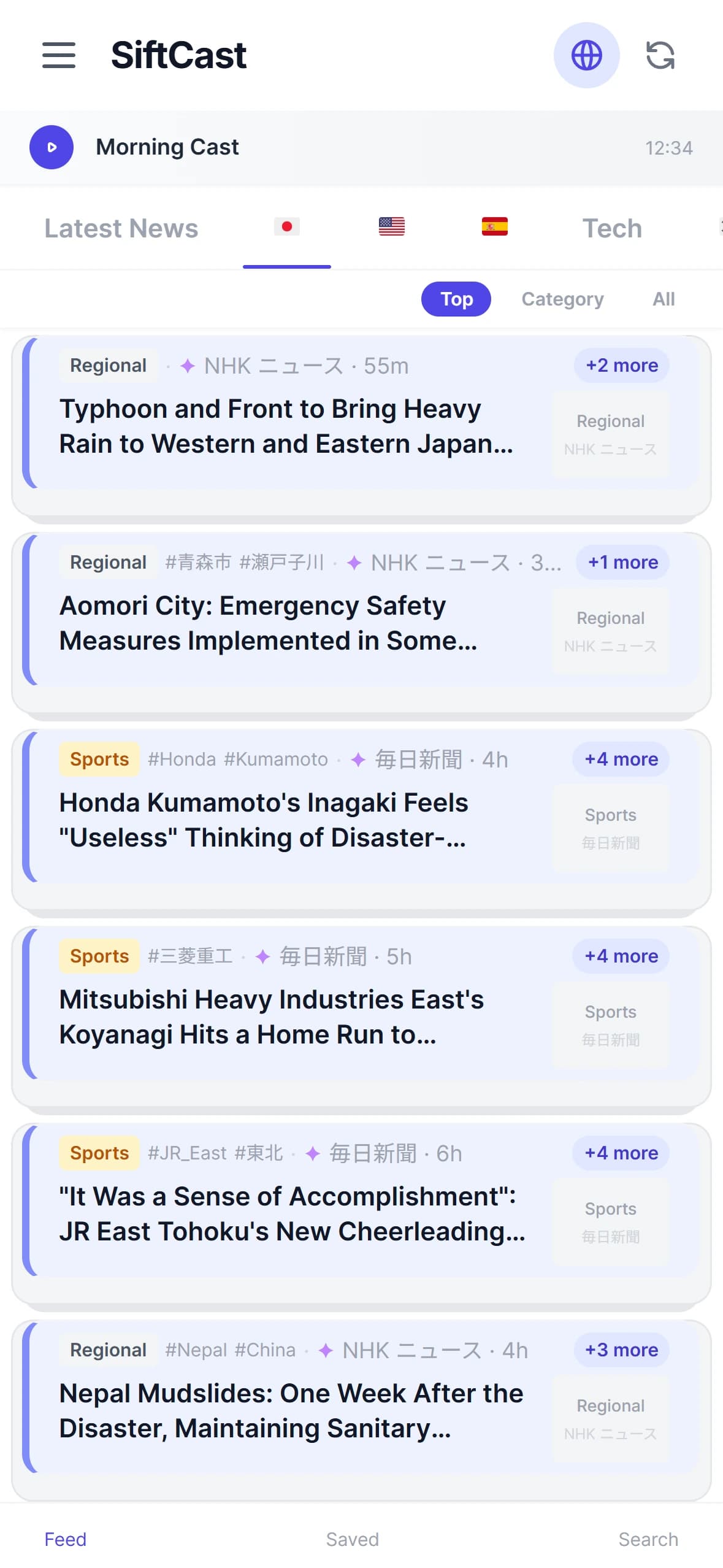
  • Stack viewAI auto-groups articles on the same topic
  • Sift InsightsSummarizes an article's background and context in two sentences (natively generated in JA/EN)
  • Automatic category and topic classificationA 15-category badge plus auto-extracted proper-noun tags (up to 3)
  • Shared-topic groupingLinks a topic shared across articles to a "Topic" header
02

Multilingual Architecture (an advanced multilingual translation pipeline)

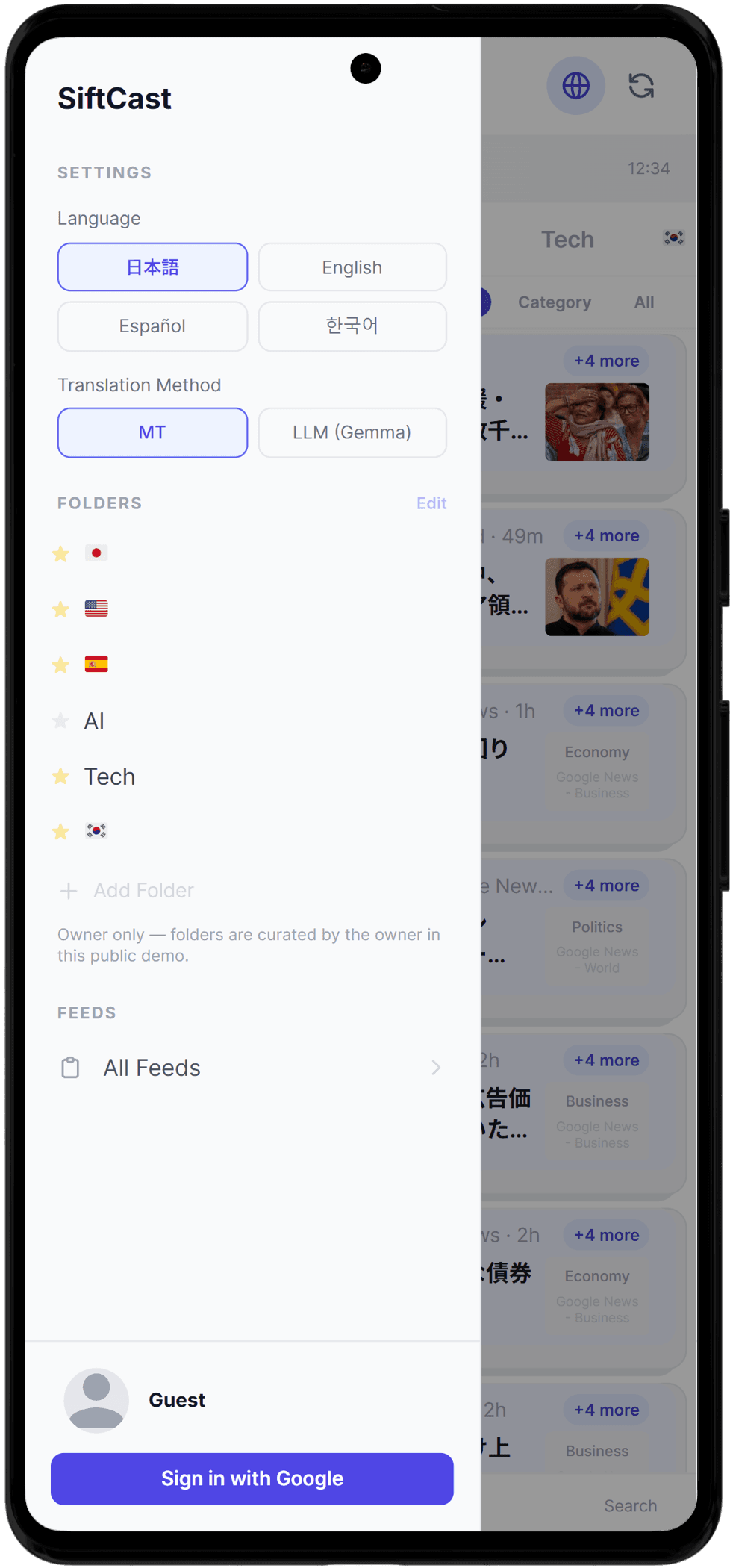
  • Bulk title translationInstantly translates every title in the feed into your chosen language (JA/EN/ES/KO)
  • In-drawer translationTranslate RSS summaries and AI insights in one tap
  • Translation-engine choiceChoose speed-first Standard (DeepL/Google) or high-quality Gemma
Custom News Feed & Piping (flexible data aggregation and source management)
03

Custom News Feed & Piping (flexible data aggregation and source management)

  • 50+ RSS feedsCovers major media across Japan, the US, Europe, and Asia, plus tech and AI blogs
  • Custom foldersYour own views combining sources and category tags freely
  • Feed searchFilter all feeds by name or category
04

Streamlined UI/UX (a noise-free reading experience with media integration)

  • Multi-view displaySwitch among three views — Category, All, and Featured
  • Automatic YouTube suggestionsEmbeds related videos inline based on article context
  • Folder managementPin favorites and reorder with drag and drop
Robust App Experience (convenience optimized on web-standard technology)
05

Robust App Experience (convenience optimized on web-standard technology)

  • PWA supportAdd to home screen plus Service Worker caching for native-like behavior
  • Google sign-inSecurely syncs folders and favorites via OAuth
  • Persistent settingsSaves display language and translation engine in the browser for next time

03Tech stack

TBD

04Why I built this

Relocating to Spain meant daily research across four languages: Japanese, Spanish, English, and Korean. Managing varied formats and linguistic structures highlighted a clear problem: workflow fragmentation.

Translation tools handle words, but extracting context from noise still takes work.

Bouncing between news portals and local sources was tedious—spending time just compiling high-level overviews left little energy for deep-dive research.

I built a single-page workspace to bridge quick overviews with deep research, designed to scale across European and Asian sources. Uniting dense aggregation with fluid UI, it condenses the entire research pipeline into one view.

  • Frictionless multi-region tracking, without tab fatigue
  • Seamless transitions from overviews to deep dives
  • Modular source structure for custom feeds

— The Outcome —

Four separate actions—searching, translating, background checks, and media lookups—are now consolidated into a single interface.


05Engineering decisions

01

Pushed collection, normalization, and LLM classification onto an async backend so organized data is already there at launch

PROBLEMPiping RSS from different language spheres and formats straight through lets the differences and noise wreck the UX

I designed data collection, schema normalization, and LLM classification/grouping as a fully asynchronous backend pipeline. As a principle, the moment the user opens the app a highly structured, organized data stream is already complete. Each processing step is implemented as loosely coupled modules so it can withstand rising load.

Absorbs format differences and noise behind the scenes, presenting an organized stream the instant you open it
02

Ditched static feeds so that auto-grouping and custom folders let users build their own stream

PROBLEMThe context-switching that comes from shuttling across multiple sources and languages was the biggest barrier to digging deeper

I auto-group multiple sources covering the same topic (stack view) and auto-link common topics (Topic headers), consolidating the thread of a story into a single stream. Rather than handing over one static feed, I structured it as "custom folders" that freely cross sources with category tags and reorder by drag and drop, letting users build their own pipeline.

The thread of a story stays intact even across sources, and you can recompose the stream around your own interests
03

Chose a stable paid VPS over a free tier as the foundation, making the stability of async AI processing a precondition of product quality

PROBLEMSince AI classification, summarization, and translation run in parallel in the background, server stability directly determines the quality of the experience

Because the design runs AI article classification, LLM summarization, and translation in parallel in the background, server stability directly drives experience quality. To avoid the instability of a free tier while keeping costs down, I chose a reasonably priced paid VPS rather than a free plan. To make "processing that completes out of the user's sight" the default, I defined infrastructure reliability as a precondition of product quality.

Runs parallel AI processing reliably, keeping its very existence out of the user's awareness
04

Adopted a language-agnostic abstract schema and a PWA to get both easy source expansion and fast startup

PROBLEMI wanted to avoid a design that had to be rebuilt every time I added Asian or European sources

I designed an RSS-based abstract data pipeline that doesn't depend on language structure or domain characteristics, making it easy to add new sources like Taiwan or Chinese. Alongside that, treating startup speed and mobile ease as top priorities for a daily news-reading tool, I adopted a PWA. Combined with a Service Worker caching strategy, it achieves lightweight performance on par with a native app.

Keeps the cost of adding sources from new language spheres low while securing native-level startup speed

Try it out

No signup required — guest mode available